

In The Gentle Art of Swedish Death Cleaning, you learn to sort your belongings while you still have the time and energy to decide what stays, what leaves, and what your loved ones will eventually handle. Margareta Magnusson’s central lesson gives you a practical reason to simplify: every decision you make now reduces the guesswork someone else inherits.
You also get permission to enjoy your possessions. Through stories about family life and objects with unexpected histories, Magnusson presents minimalism as a way to make daily living easier while keeping room for affection.
If you want a thoughtful companion to downsizing or decluttering, the gentle art of swedish death cleaning book offers a useful starting point.
Author Margareta Magnusson shows how streamlining your life creates peace of mind for you and your family. You bring your own pace, circumstances, and attachments to the process.
Table of Contents
Who Was Margareta Magnusson, and What Is Her Book About?

You meet Margareta Magnusson, a Swedish artist who turns the experience of sorting family possessions into candid advice about responsibility and everyday comfort.
Her version of death cleaning asks you to consider both your present needs and the work your belongings will eventually require. Through streamlining your life, you build a calm and manageable space.
The Artist and Personal Experiences Behind the Book
You encounter Magnusson through her experiences as an artist, mother, and widow. Her perspective developed through moving between homes and clearing belongings after family deaths, including her husband’s.
Reading her work today also means recognizing that Magnusson died in March 2026. Her advice remains grounded in the practical experience of being the person left to make difficult decisions while grieving.
You feel that background throughout the book. A cupboard contains household goods, but sorting it also brings up questions about family habits, private memories, and who wants what.
What Does Döstädning Mean?
You can translate döstädning directly: dö means death, and städning means cleaning. In Magnusson’s usage, you remove unnecessary possessions and put your home in order with your eventual absence in mind.
Your work includes deciding what deserves space and making belongings easier to manage. Ordinary household cleaning continues alongside that larger task.
Through minimalism in daily life, you apply a similar question to everyday choices: does this object still serve the life you lead? Death cleaning adds another consideration, the person who will handle it after you.
How Does Death Cleaning Differ from Marie Kondo’s Approach?
You shift your attention toward the future caretaker of your possessions when you follow Magnusson. With Marie Kondo’s KonMari method, you assess your relationship with belongings through a structured tidying process that includes the familiar question of whether an item sparks joy.
|
Consideration |
Magnusson’s Approach |
Kondo’s KonMari Method |
|---|---|---|
|
Central emphasis |
Your belongings’ future burden |
Your relationship with belongings |
|
Organization |
Conversational, flexible advice |
Defined category sequence |
|
Sentimental belongings |
Save for later |
Final tidying category |
You still consider happiness in Magnusson’s approach, and consideration for others fits comfortably within Kondo’s philosophy. The difference lies in emphasis; neither approach requires an emotionally empty home.
What Does the Book Cover Chapter by Chapter?

You move through short reflections that connect household decisions with the experiences behind them. The book’s discussion of decluttering unfolds through stories and practical observations about organizing your home.
How the Short Chapters Combine Memoir and Practical Advice
You spend part of your reading time considering what to do with ordinary belongings and part getting to know the person offering the advice. A discussion of kitchen equipment leads into a family memory; a cherished object explains why an apparently easy decision takes time.
That conversational structure gives you breathing room. You receive suggestions about beginning with manageable possessions and delaying emotionally demanding material, alongside reminders that belongings acquire meaning through use.
If your immediate task is a closet clean-out, the practical passages offer a foothold. The personal stories help explain why sorting takes more attention than filling donation bags.
A Plain-English Guide to Each Chapter
You get the most accurate chapter-by-chapter navigation from the contents page in your edition. The notes below group related passages by subject; they do not reproduce chapter titles or their sequence.
- The purpose of death cleaning: You consider the effort your belongings require and the decisions you want to make yourself.
- Family experiences: You see how clearing relatives’ homes shaped Magnusson’s views about preparation and grief.
- Getting underway: You receive encouragement to begin with easier possessions and leave absorbing memories until later.
- Clothing and household storage: You consider what you use and how a designated place helps you find it.
- Books and kitchen belongings: You examine quantities, usefulness, and whether someone else wants an item.
- Private possessions: You confront the question of what another person will discover and have to interpret.
- Photographs and personal keepsakes: You consider selection, preservation, and objects whose meaning belongs chiefly to you.
- Life after sorting: You return to the pleasures that a more manageable home leaves time to enjoy.
When you reduce an overcrowded book collection, for example, you face both practical limits and personal history. That combination runs through Magnusson’s advice.
Which Lessons Make Magnusson’s Approach Distinctive?
You are encouraged to take responsibility for your belongings while respecting your attachment to them. The most memorable advice concerns possessions that ordinary organizing categories handle poorly, including private letters and gifts loaded with expectations.
The “Throw Away” Box: Keeping Memories Others Need Not Inherit
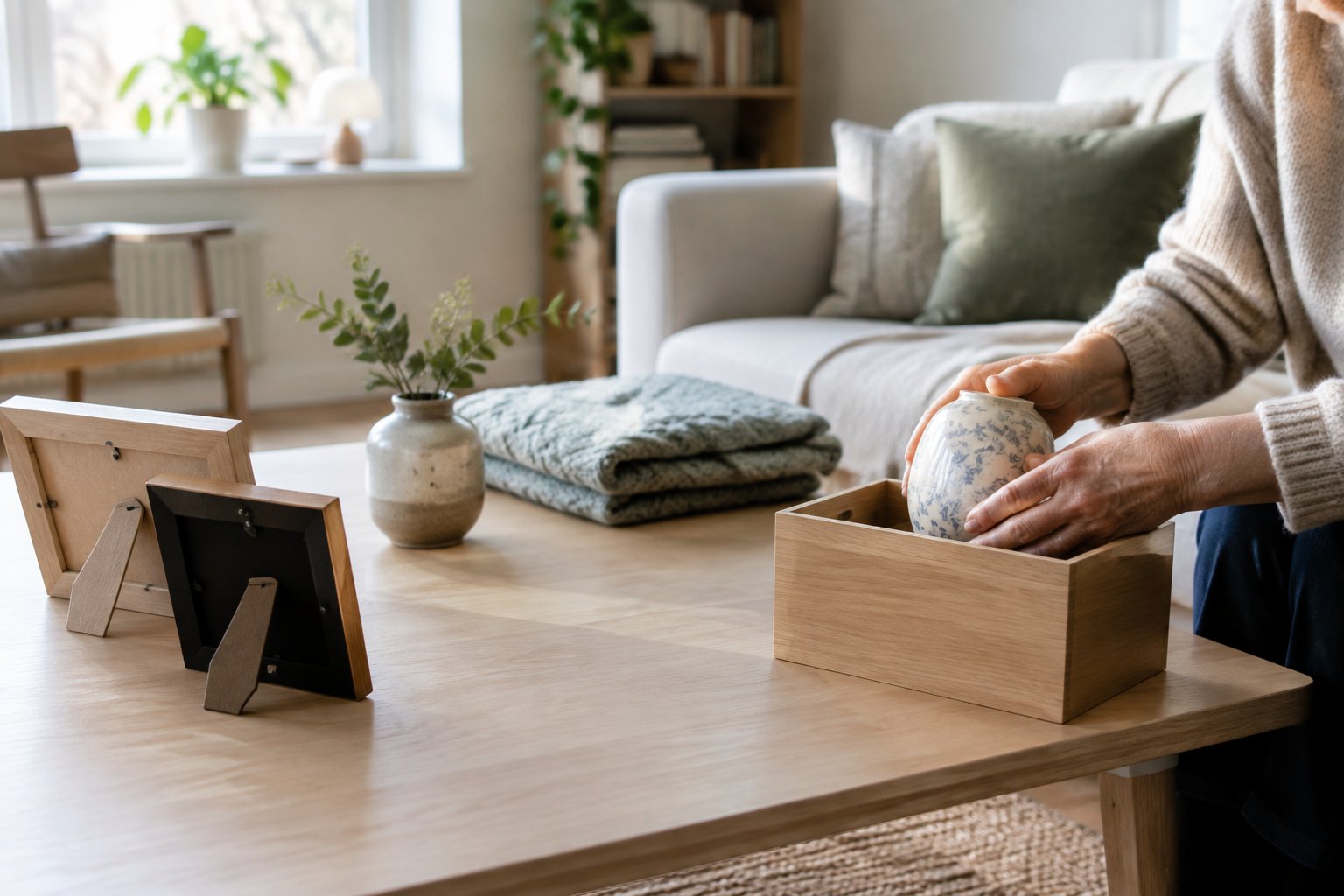
You give deeply personal keepsakes a clear boundary with Magnusson’s “Throw Away” box. Inside, you keep small objects that you enjoy revisiting but that hold little meaning for anyone else.
The label gives your survivors permission to discard the contents after your death. You retain the pleasure of a memory without asking someone else to preserve its physical evidence indefinitely.
As you work on letting go of sentimental clutter, this distinction is useful: a private keepsake deserves a place in your life even when it has no future role as an heirloom.
Why Photographs and Love Letters Deserve Unhurried Decisions
You save photographs and letters for later because they invite sustained attention. Opening an album while sorting a storage cupboard quickly turns a practical task into an afternoon of remembering.
Magnusson’s advice allows you to keep selected sentimental belongings. You encounter an approach that makes room for attachment, including photographs and love letters.
For your own sorting, adding names and dates to retained photographs is a useful editorial extension of that principle. You give future viewers context that an unlabeled image cannot supply.
Handling Secret Things Without Leaving Difficult Decisions Behind
You decide what happens to private possessions while you still control the choice. Magnusson addresses hidden belongings and intimate material that would leave someone else facing uncomfortable questions.
Your privacy decisions deserve care. Before destroying papers, separate personal correspondence from financial records and documents with legal significance.
For digital material, a present-day extension is to document account-access wishes using secure methods. Your passwords require protection during your lifetime, and your estate arrangements deserve advice suited to your circumstances.
Giving Possessions as Gifts Without Passing Along an Obligation
You make giving considerate by finding out whether the recipient wants the object. Magnusson’s approach includes passing possessions along during your lifetime, with the pleasure of seeing someone use them.
An offer works best when refusal is easy. You might explain the history of a serving dish, then ask whether it fits the recipient’s household.
When you are learning how to let go of material possessions, separate your affection for an object from another person’s willingness to store it. A declined gift leaves you free to choose another destination.
Letting Go to Make More Room for Living
You judge progress partly by how your home supports your current activities. A smaller inventory reduces the possessions you must locate, maintain, and eventually distribute.
Margareta Magnusson keeps returning to enjoyment: you are preparing your surroundings for the life you still have. Streamlining your life includes keeping objects that support your interests and pleasures.
A useful application is to identify what released space will support. Your cleared table might become usable for meals, while an accessible shelf holds the hobby supplies you reach for each week.
Who Should Read It, and What Should Readers Expect?
You are a good match for this book if you want thoughtful encouragement while deciding what to keep and what to pass along. You will get the most from its conversational guidance when you are comfortable shaping your own working plan.
Readers Facing Downsizing, Family Conversations, or Everyday Clutter
You might reach for the book during a move, after an inheritance, or when accumulated belongings begin to complicate daily routines. Its family perspective is especially relevant if you have already cleared someone else’s home.
For decluttering in later life, practical considerations include energy, accessibility, and the amount of help available. Magnusson’s reflections give you language for discussing possessions before decisions become urgent.
If you are raising the subject with a relative, keep ownership clear. You are offering assistance; their belongings remain theirs to decide about.
A Short, Gentle Read Rather Than a Step-by-Step Manual
You should expect brief reflections, household advice, and stories from Magnusson’s life. Your reading experience feels conversational, with room for tangents and dry humor.
If you prefer schedules and detailed worksheets, you will need to create your own structure around the reading. An editorial way to do that is to pair each reading session with one manageable category.
For organizing a minimalist home, you still need practical decisions about storage locations and removal arrangements. The book supplies motivation and perspective while leaving those details to your circumstances.
What Newspaper Reviews Highlight About the Book
You get a useful sense of the tone from the newspaper praise collected for the book. Major outlets, including The New York Times, have recognized its warm balance of honesty and charm.
The New York Times called it a “fond and wise little book”. Meanwhile, The Washington Post emphasized personal responsibility and the burden possessions leave for family and friends.
Coverage in The Washington Post noted how practical sorting spares survivors needless grief. Similarly, The New York Post highlighted the familiar connection with keeping belongings you love, adding an awareness of mortality.
Reviews in The New York Post also stressed the humor tucked into her pragmatic wisdom. Together, those responses point you toward the book’s mixture of affection and frankness.
Your expectations should leave room for both qualities. You will encounter practical suggestions alongside personal digressions about the life surrounding the objects.
Where to Find a Copy Without Shopping Pressure
You have several ways to read the book, including borrowing, buying used, or choosing a digital edition. Availability includes Amazon and bookstores; your public library’s catalog will show whether local borrowing options exist.
For the US edition, you can distinguish the book through its subtitle, How to Free Yourself and Your Family from a Lifetime of Clutter. Listings also vary across markets and editions.
If you are practicing minimalism in a consumer-driven society, the format is another intentional choice. You need access to the ideas, with ownership optional.
Keep What Matters and Leave Less for Others to Manage
You take the book’s most useful lesson into everyday decisions: keep what supports your life and make clear arrangements for what remains. Magnusson gives you permission to approach that work gradually, with affection for the objects you choose to retain.
Through intentional living and mindful consumption, you also consider what enters your home after a clear-out. Minimalism becomes easier to maintain when incoming belongings have a purpose and an available place.
Key Takeaways
- You reduce future guesswork by making decisions about your possessions yourself.
- You give photographs and private keepsakes the time they require.
- You offer gifts with room for the recipient to decline.
For a manageable application, choose a low-emotion category and identify where the outgoing items will go. Leave photographs for a separate session with enough time to read the notes on their backs.
Frequently Asked Questions
You can approach Swedish death cleaning at different stages of life, with room for sentimental belongings and your own pace. These practical distinctions help you decide how Magnusson’s book fits your needs.
Do you need to be older to benefit from this book?
You can benefit whenever your belongings become difficult to manage or you want to prepare for a change in circumstances. Magnusson’s perspective comes from later life, but the questions apply to your next move or an overcrowded home at any age.
Does Magnusson recommend getting rid of sentimental belongings?
You have room to keep sentimental belongings in Magnusson’s approach. Her “Throw Away” box gives private keepsakes a home while making their eventual disposal easier for someone else.
Is the book a practical decluttering manual or a memoir?
You get a blend of personal reflection and practical decluttering advice. Expect stories that explain Magnusson’s thinking, with flexible suggestions you adapt to your household.
Is there a legal PDF or ebook edition?
You can read an authorized ebook edition of The Gentle Art of Swedish Death Cleaning through legitimate digital retailers, with borrowing availability determined by your library. A file labeled “PDF” might contain a sample or summary, so check the publisher, edition, and access terms before treating it as the complete book.
How is the book related to the Swedish death cleaning TV show?
You encounter the same underlying idea in the television adaptation: sorting possessions while reflecting on the life attached to them. The book inspired a US television series launched in 2023; its personal stories and advice remain distinct from the program’s participants and on-screen projects.