



Walk into a room where every surface holds something waiting for your attention, a stack of mail, a pile of laundry, a shelf of half finished projects, and your brain reacts to it the same way it reacts to a to-do list left open on your desk. It does not file the mess away as background. It keeps a small process running, checking in, nudging you. That nudge is not a character flaw or a sign you need to be tidier. It is how the brain is built to handle incomplete tasks, and it explains a lot about why a cluttered room feels heavier than it looks.
Table of Contents
Your brain treats a messy room like unfinished work
Psychologists have long described something called the Zeigarnik effect: unfinished tasks stay active in memory far longer than completed ones. Once a task is done, the brain lets go of it. Until then, it keeps a thread of attention tied to it, a low hum in the background that resurfaces at odd moments.
A cluttered room is full of unfinished tasks stacked on top of each other. The jacket on the chair is a decision not yet made about where it goes. The pile of papers is a sorting job not yet done. The drawer that will not close is a small repair deferred. None of these are urgent on their own, but your brain does not file them as “later.” It files them as “open,” and open items draw attention whether you want them to or not.
This is different from being lazy or disorganized. It is a basic feature of how memory and attention work. The more open loops a room contains, the more background processing your brain is doing just to exist in that space, and that processing has a cost even when you are not consciously thinking about the mess.
Visual clutter and the limits of attention
Attention is a limited resource, and the visual system has to decide, many times a second, what deserves focus and what gets filtered out. In a clean, sparse room, that filtering is easy. There are few objects competing for notice, so the brain can settle on what you actually came to do.

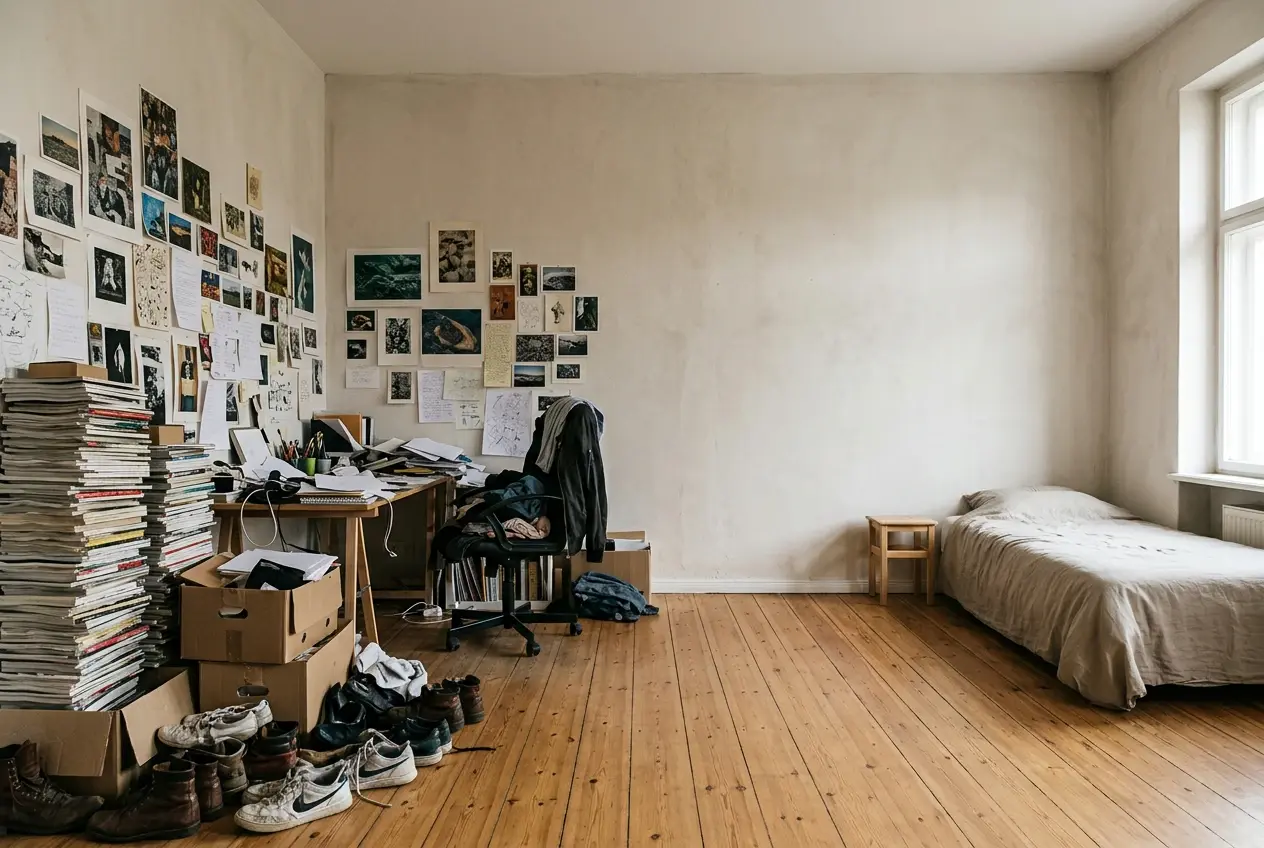
In a cluttered room, every object is a small competitor for visual attention. Research on visual processing has shown that more objects in a field of view means more competition for the brain’s limited attentional resources, even when you are deliberately trying to ignore most of them. You are not consciously registering the stack of magazines or the pile of shoes by the door, but your visual system is still processing them, still allocating some share of attention to sort them as irrelevant.
This is part of why working in a cluttered space feels more tiring than working in a clear one, even when the task itself has not changed. The task is the same, but the background cost of filtering out everything else is higher. A clear room removes that cost. There is less for the eyes to sort, so there is more attention left for the thing you actually want to focus on.
Decision fatigue: why fewer objects means fewer tiny choices
Every object in a room is a small decision generator. Which shirt to wear, where to put the mug when you are done with it, whether to deal with the pile on the counter now or later. None of these decisions feel significant individually. The problem is volume.


Decision fatigue describes how the quality of decisions declines after a long string of them, regardless of how small each one is. The brain does not distinguish well between a decision about what to wear and a decision about a work project in terms of the mental resource it draws on. Both pull from the same limited pool.
A home with fewer possessions presents fewer of these micro-decisions. Fewer clothes means less deciding. Fewer surfaces covered in objects means fewer moments where you have to choose what to do with something. This is one of the more practical links between minimalism and mental clarity: it is not that the objects themselves are stressful, it is that each one asks something of you, and those small asks add up over a day in a way most people never notice until the asking stops.
What happens to stress hormones in a cleared space
The body’s stress response does not only activate during obvious emergencies. It also responds to ongoing, low-grade signals of disorder in the environment. A cluttered space can function as one of those signals, something the nervous system reads as unresolved or unsafe in a mild, chronic way rather than an acute one.
Cortisol, the body’s primary stress hormone, rises in response to a wide range of triggers, including environments that feel chaotic or out of control. Studies looking at cortisol levels in people describing their homes as cluttered versus clear have found a connection between higher clutter and higher stress hormone markers, particularly in women managing household responsibilities. The mechanism is not dramatic. It is a steady, low-level activation rather than a spike, which is exactly why it is easy to miss while it is happening.

A cleared space does not eliminate stress, but it removes one of the steady inputs that keeps the stress response mildly activated. That is part of why people often describe feeling calmer within minutes of clearing a space, not because the clearing solved a major problem, but because it took away a background signal the nervous system had been responding to the whole time.
The space-mind feedback loop: how disorder and anxiety reinforce each other
Clutter and stress do not just coexist. They reinforce each other. A stressed mind has less capacity for the kind of sustained attention and energy that sorting and organizing requires, so clutter tends to accumulate faster during stressful periods. That growing clutter then adds its own low-grade stress signal on top of whatever was already there.
This creates a loop. Stress makes it harder to deal with disorder, disorder adds to the stress, and the two feed each other in a cycle that can be hard to interrupt from either end. It is one reason “just clean up” is not useful advice during a genuinely stressful stretch. It asks for exactly the resource that stress has already depleted.
Breaking the loop usually works better from the environment side than the mind side, because clearing a space does not require the same sustained mental energy that resolving the underlying stressor might. Once the clutter eases, some of the background stress signal eases with it, which frees up a bit more capacity to deal with whatever started the cycle in the first place.
Why clearing one surface can calm you faster than clearing a whole room
The scale of the clearing matters less than people expect. Clearing a single surface, a kitchen counter, a desk, the top of a dresser, produces a noticeable shift in how a room feels, often faster than tackling the whole room would.
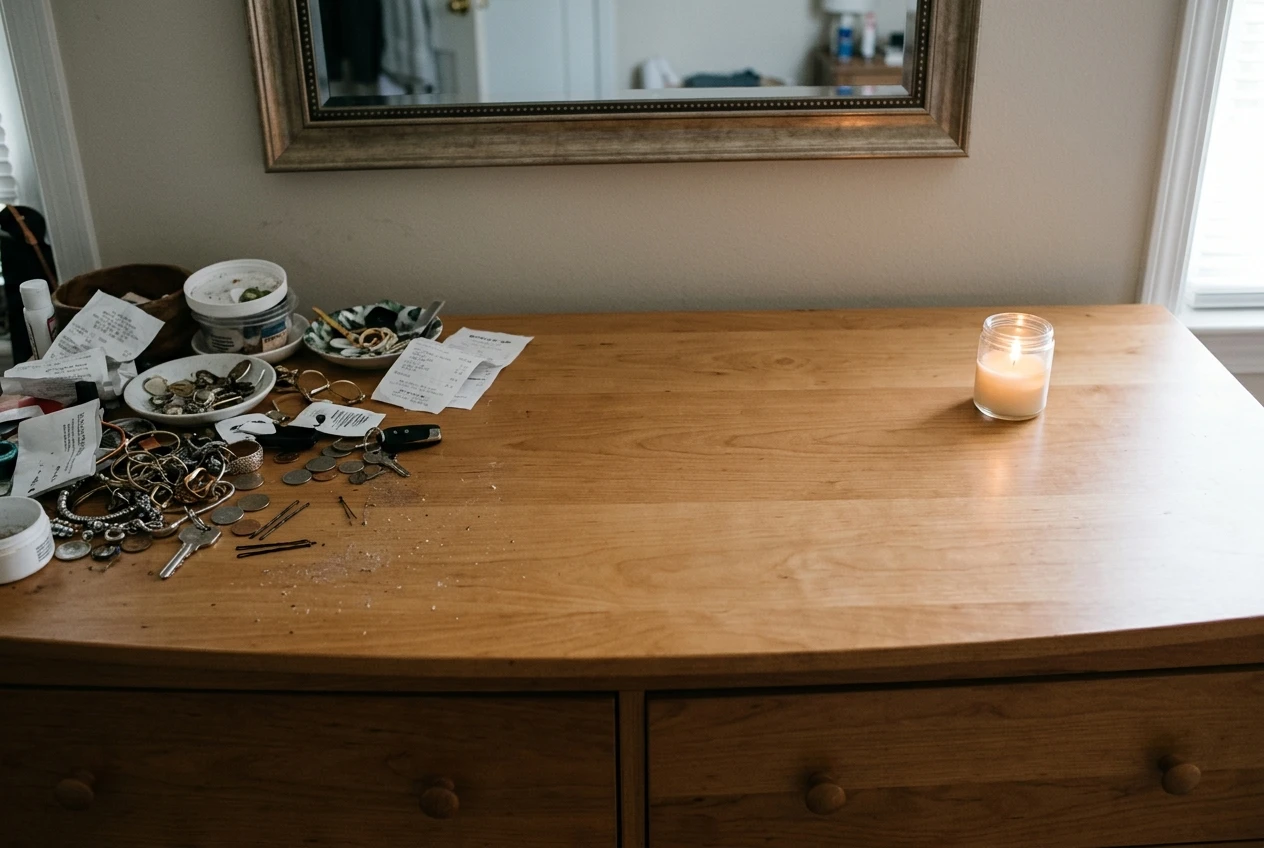

Part of this is visual. A cleared surface gives the eye a resting point, somewhere with nothing competing for attention, and that rest spreads to how the rest of the room reads even if nothing else has changed. Part of it is psychological. Finishing a small, contained task provides the sense of closure the Zeigarnik effect craves. A defined boundary like one counter or one shelf is easier to complete fully than “clean the room,” which rarely has a clear endpoint and so rarely delivers that same sense of closure.
This is useful to know because it means the payoff does not require a weekend project. A single cleared surface, finished completely, can shift how a room feels more than a half-finished attempt at the whole space.
Keeping the calm: small habits that protect the effect

The calm that follows a cleared space fades if the space fills back up, which it generally will unless something keeps it from accumulating. A few habits protect the effect without requiring constant vigilance:
- Deal with an item once. Decide where something belongs the moment it enters the space instead of setting it down to decide later.
- Keep one surface permanently clear, as an anchor the eye can rest on even when other areas get busy.
- Do a short daily reset, putting a handful of things back where they belong before the day ends, rather than waiting for a buildup large enough to require a project.
- Notice what tends to pile up in your space specifically, and address that pattern rather than treating all clutter as the same.
If this makes you want to feel the effect yourself rather than just read about it, start with one closet using the steps in this closet clean out guide, then notice how the rest of the room feels by comparison.